

Low-probability, high-consequence incidents. How do rescue operations in the Wood River Valley prepare for a backcountry rescue like a large multi-burial avalanche? It’s complex, high-stakes, and no single agency could handle it alone.
For many years, the Ketchum Fire District (KFD) hosted a pre-winter meeting for the valley’s avalanche response teams to evaluate plans for multi-agency rescues. These meetings, however, remained informal and did not include joint training.
When the COVID-19 pandemic hit, backcountry recreation in Blaine County increased significantly. With that increase came a greater risk of multi-victim avalanche incidents. Then, in the winter of 2022, the Sawtooth Avalanche Center invited avalanche rescue expert Manuel Genswein to serve as an advisor for the season. Genswein, a Swiss researcher and developer of rescue equipment and techniques used worldwide, urged local responders to create a formalized rescue group modeled after Europe’s highly trained mountain rescue teams.
KFD’s Captain David O’Donnell, backcountry rescue coordinator, explained, “The standard for helicopter-based rescue in Europe is very high. Manuel was basically telling us it’s time to step it up.”
Another key catalyst was Dr. Terry O’Connor, a respected Ketchum physician, medical director and avid mountain recreationist who tragically died in an avalanche on Donaldson Peak in May 2024.
“Terry always had a really grand vision of what backcountry rescue could be like in our valley,” added Drew Daly, ski patroller, guide and operations manager for Sun Valley Heli Ski (SVHS). “He encouraged us to get all the entities together and enlisted Manuel to roll it out.”

Initially, KFD, SVHS, and the Sun Valley Ski Patrol (SVSP) joined forces, as they each brought special abilities to the endeavor: KFD had experience with command and control structures, SVHS quite often had a helicopter, pilot, and experienced guides in the area, and the patrol offered a large number of ready rescuers who were in skis and boots, at altitude (9,200 feet), and trained in avalanche terrain travel and rescue. At Genswein’s urging, O’Donnell for KFD, Daly for SVHS, and Adam Tanous, former chief training officer for SVSP, began meeting regularly to plan joint training exercises, the first being in January 2022. A number of other groups and agencies soon joined the mix, including Wood River Fire, Sun Valley Guides, Sawtooth Mountain Guides, Sun Valley Fire Department, the Blaine County Sheriff’s Office, Air St. Luke’s, and Blaine Avalanche and Rescue K9s. The collaboration led to the creation of the Idaho Central Mountain Rescue Group (ICMRG).
“These types of rescues, with helicopters, multiple victims, and multiple rescuers in avalanche terrain are difficult and fairly complex,” Tanous noted. “In that first exercise, we learned a tremendous amount about the value of training together across agencies. When it comes to avalanche rescue, it’s all about safety and time efficiency. Joint exercises make that possible.”
The ICMRG is spearheaded by KFD, which provides the ambulance service for northern Blaine County. Under the direction of O’Donnell, the group shares knowledge, equipment, and expertise to ensure a rapid, coordinated and practiced rescue response.
Since 2022, ICMRG participants have honed their skills through three annual trainings: a tabletop communications exercise using the Incident Management System (NIMS); a ground-based scenario in “no-fly conditions”; and a helicopter training that incorporates the transportation of rescuers to a rescue site and multi-patient extrications from a remote location.
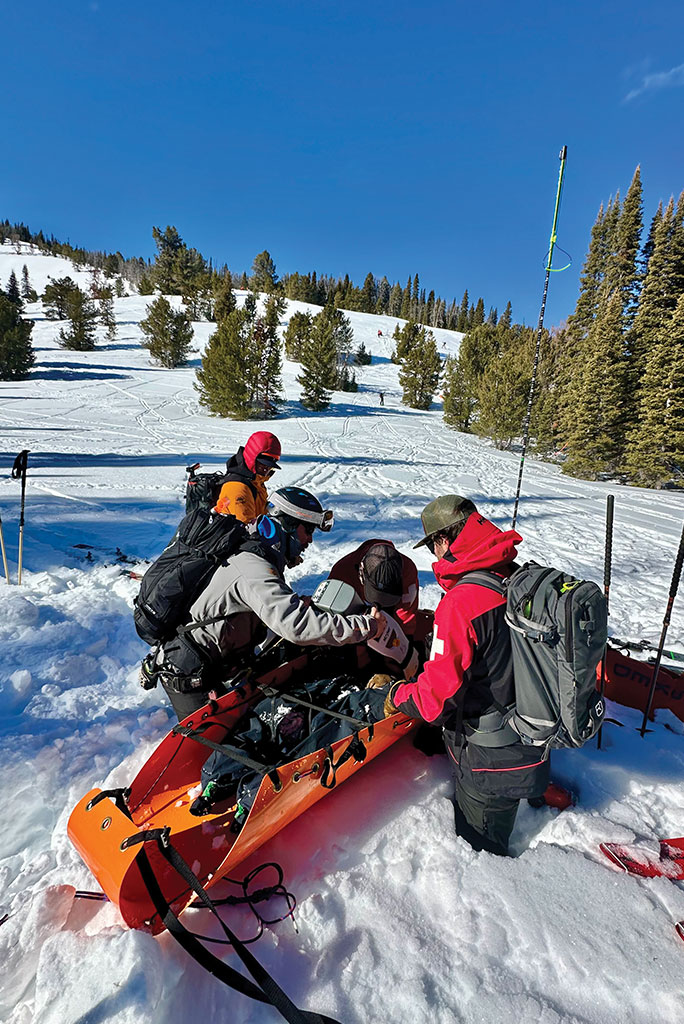
During the ground scenario, responders travel by snowmobile or skis to a designated site carrying full rescue gear. The simulated avalanche tests participants’ skills in locating multiple “victims” using avalanche dogs, transceivers, RECCO detectors, and probe lines. Each “victim” has injuries, forcing quick decisions on triage, treatment and extrication.
The helicopter scenario mirrors the ground exercise, adding air coordination and patient transport to the challenge. Units assemble under an Incident Command System (ICS), establish communications, and conduct systematic searches. Once victims are located, rescuers practice patient packaging and airlifting procedures. These drills refine interagency coordination and communication under real-time pressure.
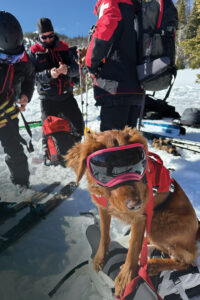
In the 2025 air exercise, the “on-scene” time was just 38 minutes according to O’Donnell, who described the exercise: “KFD dispatched the SVHS helicopter to pick up five rescue-ready ski patrollers and a dog from Baldy and fly them directly to the scene. All agencies were already briefed on the comms plan at the tabletop exercise. Air St. Luke’s dispatched a transport helicopter to help insert more rescuers and extract patients. SVFD, Blaine County South, Sawtooth Mountain Guides, and Sun Valley Guides sent personnel into the field. Teams in the field relayed medical information to the operations post and assigned priorities to each patient. Multiple agencies attacking the same problem. That doesn’t happen unless you practice together. That’s the purpose of ICMRG.”
These operations require significant resources, particularly helicopter time. Blaine County lacks a dedicated helicopter rescue program like Teton County Search and Rescue, relying instead on a contract with SVHS to partner with local EMS agencies to assist in rapid response and transport. There is, however, new this year a 24-7 helicopter presence in the Wood River Valley by both Air St. Luke’s and St. Alphonsus Life Flight Network.
“There has always been a connection between guiding and the rescue community,” said Daly, “Over the years, SVHS has put in so much flight time and guides’ time into rescues and trainings.”
If enough funding were to be secured, it is possible ICMRG could realize its dream of providing the county with a special rescue helicopter and team, relieving some pressure from local agencies and guiding operations, and cutting down on response time. In the meantime, to sustain the mission and ensure ongoing preparedness, ICMRG has established a charitable fund with the SPUR Community Foundation, a trusted 501(c)(3) organization committed to assisting positive endeavors in the Wood River Valley.
 Ultimately, the group aims to establish ICMRG as a nonprofit itself with IRS 501(c)(3) tax-exempt status. But as Daly points out, running a nonprofit is time consuming: “Organizing this training is a community effort. No one has the time and resources to be the full-time director.”
Perhaps one day the group will be able to hire a full-time executive director. Until then, the focus remains on training as much as possible to provide a professional response to avalanche accidents.
“Unfortunately, we’ve assisted in a couple of avalanche recoveries after time ran out,” said O’Donnell. “That highlights the importance of the early SOS activation. Partner rescue is critical but so is calling early. We are training hard to respond efficiently, but the clock only starts when we’re notified.”
In the chaos of a real rescue, hesitation or confusion can cost lives. That’s why repeated training is so crucial. People don’t fall to the level of their training; they rise to it. Each responder bears a personal responsibility to know his or her role, stay calm, and behave with confidence. It is this sense of responsibility, paired with preparation, that anchors everything ICMRG does and aims to do for the community.
Terminology
Transceivers
Electronic devices used to help locate buried avalanche victims. They work by emitting radio signals that other transceivers nearby can detect. Rescuers turn on their transceivers to search for the exact location of the buried person. Transceivers greatly increase the chance of a successful rescue.
RECCO
A technology used in search and rescue operations involving a small reflector that is attached to clothing or equipment. When RECCO detectors are used, the small reflectors bounce back the signals emitted by the detector.
Probe Lines
Exactly what it sounds like. Rescuers use long flexible and collapsible rods to systematically plunge into the snow to feel for a person below the surface. When organized with a line of people, probe lines can cover large sections of an avalanche path.