


Many Idahoans are avid hunters of everything from pheasant to elk. Each fall, they hunt responsibly and safely, enjoy the great outdoors and fill their freezers with high protein meat. But for folks who are seeking a hunt without a kill, shed hunting is a fun and challenging alternative.
Shed hunting is just what it sounds like—searching for naturally dropped deer, elk and moose antlers. Finding these “sheds” is like finding a treasure in the wild. They are beautiful and unique and can be quite large—one deer shed found in Nebraska in 1959—known as “The General”—measured over 207 inches, according to Field and Stream. This measurement is the length of both sides together—animal sheds come off in two distinct pieces and not always at the same time. This can add to the excitement of the hunt, because once you find one piece, you can be pretty sure that the other side of the set is somewhere nearby.
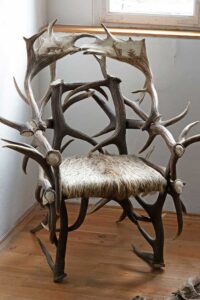
Artisans craft these unique pieces into one-of-a-kind chandeliers, candleholders, and even furniture. These sheds—when cut into manageable pieces—can also be used as pet chews for dogs; they are packed with nutrients and don’t splinter easily, making them safer than the plastic chew toys found in the pet store.
As animals shed their winter coats, the males of the species will also shed their antlers. This event is triggered by a drop in testosterone levels after the breeding season, or rut. A natural weakening at the base of the antlers or “pedicle” occurs and the blood supply to the antlers then shuts off making them brittle. The heavy antlers will then simply drop off an elk when it shakes its head or rubs against trees. The new antlers start growing immediately, and they are the fastest growing bone in the animal kingdom—sometimes growing up to three-quarters of an inch per day. This happens every year; antlers grow and then shed seasonally. The shedding enables the animals to conserve energy during the colder months, as they can eliminate unnecessary weight.
Shed hunting is a simple activity; just walk slowly and scan the terrain. Successful shed hunters stress the need to “train your eyes.” You are more likely to see just the ivory tip of a tine poking out of a bush or some ground cover versus an entire rack on the trail. The best places to find sheds are also the best places to find the animals themselves: areas with plenty of vegetation, bedding areas, and, in the colder months, south-facing slopes that provide warmth and less snow cover. Locals will attest to the abundance of deer and elk everywhere in the Wood River Valley, so you could come across the sheds on any hike or walk—you just need to be looking!
 Some hunters use trained dogs to help locate antlers. Labrador retrievers and German shorthaired pointers make great shed hunters because of their retrieving instincts and scent tracking capabilities. If dogs do come along, they should be kept close and under control so as not to put undue stress on live deer or elk that you may come across. One other consideration, particularly in the spring, is the possibility of bumping into a bear.
Beth Fox, a local shed hunter, has been hunting and finding sheds for 20 years all over the Wood River Valley. When she hunts, it’s always “a family affair,” as she puts it. All her dogs join the hunt, and she will often hunt on horseback. Fox carries a revolver and bear spray, as well as a first-aid kit, binoculars, and plenty of water. She wears a “shed backpack,” which has buckles and straps to pack out the sheds, and she wears sturdy hiking boots and carries hiking poles. One of her dogs is outfitted with a satellite collar with an SOS button that Fox can use if she is injured or in trouble and out of cell service areas.
Fox has found so many sheds that she was once able to construct a 7-foot-diameter wreath, which hangs in her barn. Next year, she plans to make an entire Christmas tree with all the sheds she found this past season.
“Always look under the sage, as they use the bushes to pop their sheds,” Fox advises. “I literally have found so many sheds because I’ll notice one point sticking out of the mud, only to find a beauty buried under the sage, leaves, and mud.”
Like most shed hunters, Fox loves being in nature and has learned a tremendous amount about how the animals migrate and roam. Learning to identify different types of antlers is also one of the great joys of shed hunting. Elk antlers are larger than deer antlers and have an almost backward curve and very distinct tines. Deer antlers are smaller and have compact points which typically fork and grow forward, and upward. Deer antlers are harder and denser than the more porous and softer elk antlers.
Shed hunting is a near perfect outdoor pursuit because whether you find the treasures or not, you’ve already accomplished your exercise, sunshine and nature goals for the day.
Guidelines and regulations from the Idaho Fish and Game
- Licenses: Idaho requires nonresidents over 12 to possess a valid Idaho hunting license to collect shed antlers.
- Seasonal Closures: While no set state-wide dates exist, Idaho Department of Fish and Game (IDFG) can implement emergency closures in winter/early spring to protect stressed deer and elk. In addition, IDFG encourages shed hunters to wait until after May 1, so as to avoid stressing wintering deer and elk herds.
- Motorized Travel: Shed hunters must remain on designated (and dry) roads and trails. Certain public lands, including Fish and Game’s Wildlife Management Areas, are often closed to unauthorized motorized vehicle traffic and can only be accessed by foot or on horseback.
- Respect Private Lands: Like all hunters, shed hunters should check with a landowner before venturing on to their property in search of antlers.
- Some Public Lands May Be Closed: Some public lands are temporarily closed during winter and early spring to provide deer and elk with disturbance-free wintering grounds.