


Since the beginning of time humans have turned their eyes upward, looking to the skies in search of meaning. The moon and stars offered a means of navigation to ancient civilizations, and the masters of the sky—falcons, hawks, owls, eagles—embodied the exhilaration and wild freedom of flight with soaring ease and the breathless, knife-edge precision of a raptor diving on prey.
Among Them, the Falcon Stands Apart
Falcons are the fastest animal on Earth. To witness a peregrine falcon stoop from the heavens—wings folded into a living blade, plunging at speeds approaching 200 miles per hour—is to encounter a force that feels almost mythic. In 1998, National Geographic video footage recorded a young female peregrine falcon, named Frightful, diving alongside a free-falling skydiver from 15,000 feet at 183 mph in a feat of extraordinary animal performance. One week later, Frightful was clocked at 242 mph. Yet numbers alone fail to capture the moment. There is an element of astonishment that accompanies this type of precision and speed. A jolting shock to the silence of the descent, the violent grace of impact, the sudden unfurling of wings as if nothing extraordinary had occurred at all.

Pen & ink sketch from U.S. Army sergeant and falconer-artist Robert Widmeier from journals when stationed in Indian (1942-1944), exhibit at The Archives of Falconry.
This is not simply flight. It represents a command of sky and mastery of the air—a realm closed to humans until the advent of the airplane in 1903.
And it is here—at the intersection of awe and inquiry—that the story of falconry begins.
A Partnership Older Than Memory
Falconry is defined as “the pursuit of wild quarry (prey) in its natural habitat,” with a trained raptor.” It is not merely a sport. It is one of the oldest recorded relationships between human and wild animal, a pursuit whose origins, as Lieutenant Colonel S. Kent Carnie, a lifelong falconer and founder of the Archives of Falconry in Boise, Idaho, suggests, are “concealed within the mists of time.”
Archaeological fragments hint at its ancient roots: pottery shards in Northern Syria dating back to 3,000 B.C.E. depicting what appears to be a falconer holding a raptor; the recent discovery of petroglyphs etched into stone in Iran depicting falconers mounted on horseback that possibly date back to around 7,000 B.C.E.; Anatolian Hittite reliefs showing figures holding both bird and quarry from around 2,000 B.C.E.; early Chinese and Persian records describing trained hawks used in coordinated hunts; or, the mummified remains of an ancient woman, found in the Xinjiang province of northwest China dating to the 2nd Century B.C.E. On her left hand and forearm, she wears a large, heavy leather falconry mitten that matches the distinctive bialeye, a protective mitt or gauntlet, worn today by the Kazakh and Kyrgyz eagle hunters in the same region.
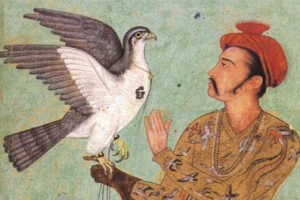
17th century Mughal imperial painting, housed in Los Angeles County Museum of Art. Bottom
Unlike agriculture or architecture, falconry left few permanent traces. Its knowledge was not carved in stone but carried in memory—passed from master to apprentice in quiet fields and windswept plains. It was an art transmitted initially through presence, not parchment.
“Early cultures known to practice falconry include nomadic tribes of the Central Asian steppe and Persia, who generally left behind little archeological evidence of their presence,” says John Goodell, executive director and chief curator at The Archives of Falconry.
And it began not with leisure, but out of necessity.
“It wasn’t a sport, it was oriented for the kitchen,” Carnie observes. “It was easier for a man to train a hawk to catch a rabbit than to run chasing one through the brush with sticks.”
From the deserts of Arabia to the steppes of Central Asia or moors of Scotland, falconry emerged as a solution—an elegant collaboration between human ingenuity and animal instinct. Over time, it became something more: a discipline of observation and a foundation for scientific thought.

Sketch by wildlife artist John P. Baumlin (2003)
The Necessity of Observation
To practice falconry is to surrender the illusion of control.
Raptors are not domesticated. They are persuaded—through patience, repetition, diligent and rapt attention, and a profound respect for their nature—to cooperate. At any moment, they can leave, flying off beyond the horizon. And sometimes, they do.
This fragile arrangement demands a particular kind of attention and falconers must learn the language of subtlety: the shift of weight on a talon, the dilation of a pupil, the slight tightening of feathers before flight. They must understand weather patterns, seasonal rhythms, prey behavior, and the invisible geometry of landscape and potential threats to survival, both known and unseen. Success depends not on dominance, but on alignment—with the bird, with the terrain and pursuit of prey, with the moment.
In the field, the falconer and raptor are a team,” says falconer Darryl Barnes. “A deep understanding of the quarry, its predilections and habits, is essential to success. Then, having set the stage and provided the opportunity for the raptor to be an aerial predator, how the story ends is up to them.”
This is not passive observation—it is active, iterative and exacting. The art of falconry is based on evidence and small, but perceptible, alterations and enhancements.
Long before the emergence of formal scientific methodology, falconers were recording, comparing, and refining their understanding of avian behavior. They tracked migration patterns, documented dietary needs, studied anatomy, and developed treatments for disease through diet, care and environment. Survival depended on it.
In this way, falconry became one of humanity’s earliest laboratories.
The First Texts of Science
By the medieval period, falconry had ascended from necessity to nobility. It became known as the “Sport of Kings,” practiced by emperors, sultans, and monarchs across continents. Yet even in its most aristocratic form, falconry retained its intellectual rigor, embodied fully by Frederick II of Hohenstaufen.
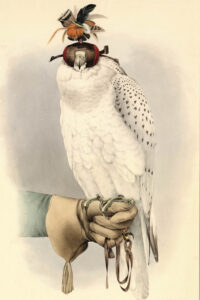
From “Traite de Fauconrerie” (Treatise on Falconry) by H. Schlegel and A.H. Verterde Wulverhorst (between 1844-1853).
In the 13th century, Frederick II—Holy Roman Emperor, linguist, and scholar—authored “De Arte Venandi cum Avibus” (“The Art of Hunting with Birds”), a work that would become one of the most influential texts in both falconry and natural science. Drawing from Arab, Persian and European sources, as well as his own extensive observations, Frederick rejected superstition, emphasized direct observation and tested hypotheses. He compiled sources and included over 900 highly detailed and naturalistic images of birds, falconers and their equipment. In doing so, he produced what many consider the first true zoological treatise—a precursor to modern ornithology.
He was not alone. Across cultures, falconry texts began to emerge: the Arabic “Kitāb dawārī al-tayr” (“Book of the Birds of Prey”), a text dating from 780 C.E., known as possibly the oldest surviving falconry treatise in the world; Chinese treatises on goshawks; Japanese illustrated manuals on hawking techniques. These works catalogued species, described behaviors, and outlined training methods with remarkable precision.
They were, in essence, early scientific documents—born not in universities, but in the field.
The Paradox of the Wild
At the heart of falconry lies a paradox.
The falconer seeks intimacy with a creature that remains fundamentally untamed. The bond is real, but it is conditional, built on trust, not ownership. “They’re wild animals,” Carnie says. “They can fly away at any point … and that is one of the great beauties of falconry, is to have that wild creature cooperate with you.”
This tension creates a unique kind of awareness.
Unlike domesticated animals, which adapt to human expectations, falcons and other birds of prey demand that humans adapt to them. The falconer must think like the bird—anticipate its needs, respect its instincts, and accept its autonomy.
This mindset—this willingness to observe without imposing—would later become a cornerstone of scientific inquiry.
It is no coincidence that many early ornithologists were also falconers.
Falconers as Conservationists
By the 20th century, the legacy of falconry had begun to merge more directly with modern science.
In 1911, Russell Luff Meredith—often called the father of American falconry—published an article describing his experiences hunting with a sharp-shinned hawk. His work helped ignite a resurgence of interest in falconry in North America, but it also contributed to a growing body of observational data about raptors. Soon after, falconers played a pivotal role in one of the most important conservation efforts in history.
The peregrine falcon, once widespread across North America, experienced catastrophic population declines in the mid-20th century due to the pesticide DDT. Falconers, who had long studied and worked with these birds, were among the first to recognize the crisis.
They became advocates. They became scientists.
Through captive breeding programs, field research, and persistent local and global advocacy, falconer-biologists helped lead the recovery of the peregrine falcon.
The Peregrine Fund—co-founded in 1970 by raptor biologist, Cornell University ornithology professor and falconer, Dr. Tom Cade, along with Bob Berry, Jim Weaver and Frank Bond—successfully bred and released thousands of birds, ultimately contributing to the species’ removal from the Endangered Species list in 1999, making this not merely a victory for conservation, but also a testament to the enduring relevance of falconry as a scientific discipline.
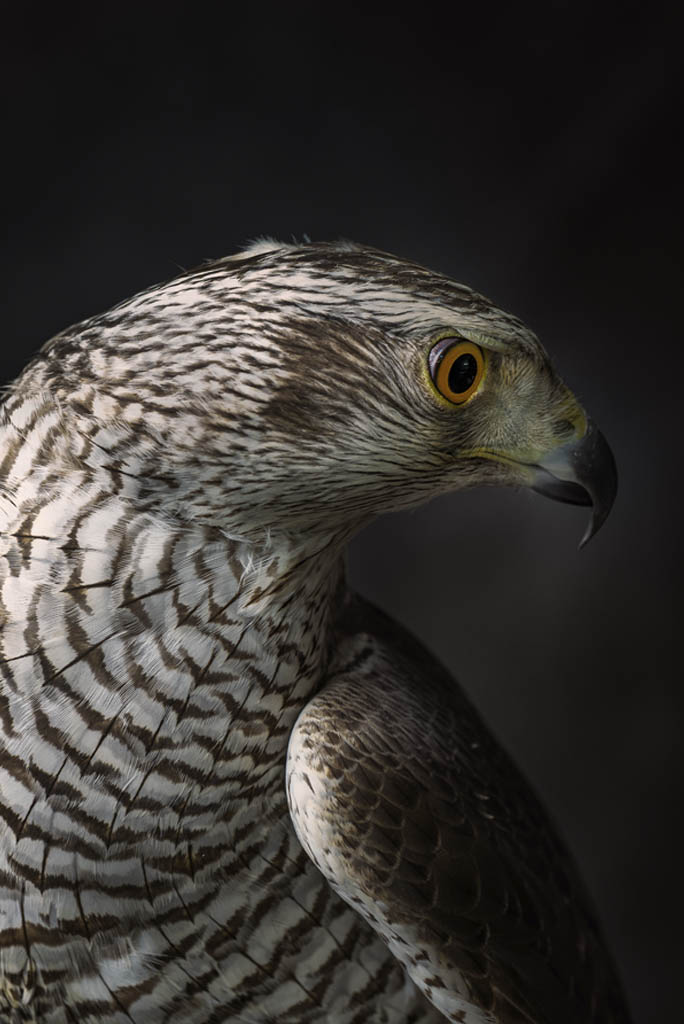
Photo by Gabe Border
A Living Heritage
In 2021, UNESCO recognized falconry as an Intangible Cultural Heritage of Humanity, acknowledging not only its historical significance, but its continued relevance. Practiced across continents by people of all backgrounds, falconry remains united by a shared ethos: respect for nature, commitment to conservation, and devotion to the craft.
Modern falconers may use radio telemetry to track their birds, but the essence of the practice remains unchanged. It is still about patience. Still about observation and learning. Still about trust.
To stand in a field with a falcon on your glove is to exist at the edge of understanding.
The bird is still, poised, coiled with potential. Its gaze is fixed on something beyond your perception, beyond human vision. In that moment, you are connected—through proximity and a form of partnership—to a world that operates on entirely different terms.
Then, without warning, the raptor launches. A few powerful wingbeats, talons tucked into the body. A blur. Then, nothing but silence. A vanishing point.
And in its wake, a question remains that has echoed through millennia: How is flight possible?
Falconry did not answer that question. But it taught us how to ask it.
The Sky as Teacher
The story of falconry is not merely the story of a sport or tradition. It is the story of how humans learned to observe the natural world with discipline and humility. It is the story of how curiosity becomes method.
From ancient petroglyphs to medieval treatises, from royal courts to modern conservation labs, falconry has shaped the way we understand birds—and, by extension, the way we understand our place within the natural world.
It is, in many respects, the quiet origin of ornithology.
It offers a simple, enduring reminder: knowledge does not always begin in books.
Sometimes, it begins in the sky.