

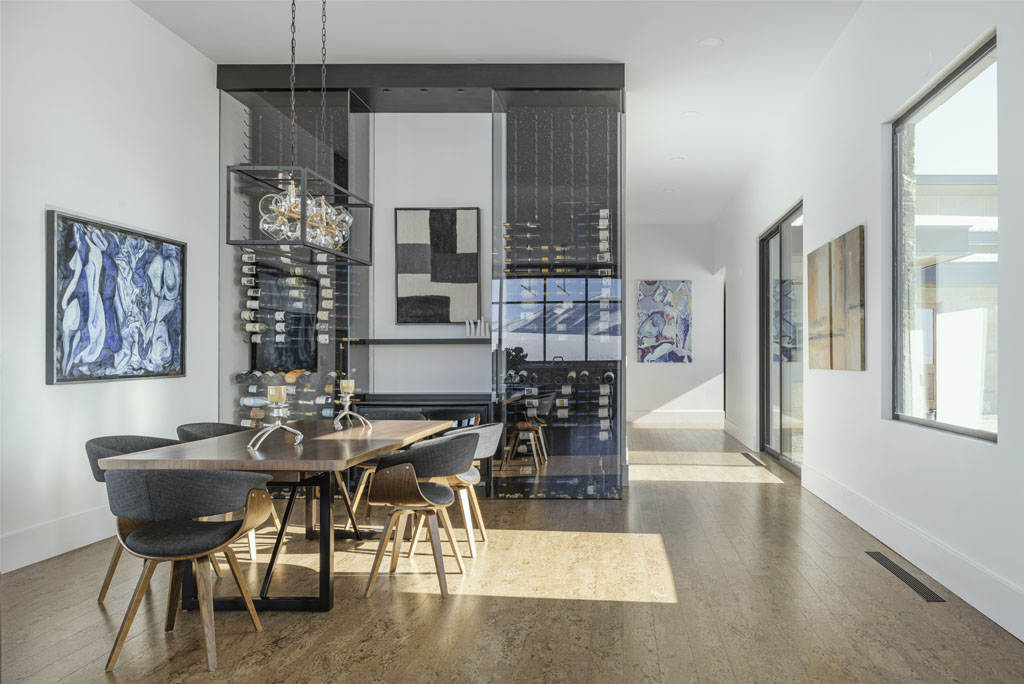
Few things in a person’s life bring about a deeper sense of calm and peace than their home. For some, home provides a shelter from the outside world, where they can nestle away from it all, while for others, a home’s safe and welcoming confines are best experienced when offered up to family, friends, and even perfect strangers. Originally born of the Latin word “hospes,” meaning guest, host, and stranger, hospitality and the gracious extension of care to guests and strangers seems to be an intrinsic trait, a genetic predisposition to generosity. One was either born with it, or not.
The ritual of hospitality for many includes the proffering of spirituous libations, a centuries-old tradition. For all the headlines in recent months that cite a decline in alcohol consumption among the younger generations as a harbinger of an existential threat to alcohol’s very existence, the custom home builders and designers of the Wood River Valley would beg to differ. From new builds to large-scale renovations, the vast majority include at least one—if not multiple spaces—solely dedicated to the storage, display and enjoyment of fine wines and spirits.
While some may consider such a space an excessive luxury, for many others a home in the Idaho mountains would be objectively incomplete without them, as practically functional as a kitchen or garage. With today’s building technology, designers and builders can create stunning spaces for not only memorable entertaining, but also the preservation of the quality and integrity of the wine and spirits as well.
 For high-end spirits, which have seen a major resurgence in popularity in the last decade, the standards of care are generally simple to adhere to and generally follow common sense. Maintaining ambient temperatures, mainly avoiding intense heat or cold and direct sunlight are the keys to keeping those 20-year-old scotches and single-barrel uncut bourbons shining in all their glory. This of course does not include liqueurs, cream-based spirts, or vermouths, which obviously need refrigeration and prompt consumption, advice often cast aside by the drinking masses to their own detriment.
When it comes to wine, however, proper care becomes a fair bit more involved. Unlike spirits, which will cease aging once they are harvested from barrels and stills, wines within a bottle are still very much changing year to year. Maintaining a narrow range of temperature between 50-55 F is just a part of the equation. Proper humidity is also critical in keeping the cork closures moist enough to stay completely sealed. Any drying of a cork will lead to the introduction of oxygen inside the bottle, eventually ruining the wine inside. For aficionados with wine collections requiring separate insurance policies, creating the perfect environment for their bottles is paramount.
Because of the number of critical technical aspects, the first step in designing a home wine room involves establishing the engineering requirements with respect to electrical load and air handling, among others. For the acclaimed Ketchum and Bozeman-based design firm Suede Studio, the development of the showstopping aesthetic elements cannot begin in earnest until the scope of the environmental requirements is properly considered.
“For us, a wine or spirits room is not a display case you tack onto the plan,” says Suede Studio founder Jennifer Hoey. “It is two rooms doing two different jobs, and the design starts with knowing which one you are solving for. Wine is a preservation problem, so it gets its own cooling and humidity control, insulated walls, and a vapor barrier that lets it hold its climate independent of the rest of the house.”
Odds are that the Wood River Valley’s nearly perpetual state of blue-sky sunshine days must be factored in as well, unless you’re hiding away in a basement, and that means selecting the right glass to keep harmful UV and passive heat gain at bay. On that, Hoey notes, “Glass changes the equation. When wine sits behind glass off a living space, we size the cooling for it from the start and coordinate with the builder early, because the mechanical load is part of the result, not an afterthought.”
Maintaining an environment that is separate from the rest of the home also means thinking about the way air moves. Pressure changes and imbalances must be monitored and typically require an entirely separate HVAC system. “These types of rooms are often one of the most complex parts of a project,” says Daniel Fairbanks, owner of Fairbanks Custom Homes. “They typically demand intricate electrical systems, as well as their own HVAC systems to ensure they function with the desired performance. “
Whether starting from scratch with a custom-built home, or creating an extraordinary space within an existing structure, the ultimate success of a wine- or spirits-focused project begins with a clear vision. From there, a road map of proper mechanical and electrical buildout will guarantee the technical performance of the space and create the blank canvas with which owners and designers will work together to truly bring the room to life with all the charm and personal finishes. Fairbanks adds, “With today’s technology and materials, there’s almost nothing someone can dream up that can’t be achieved.” ï