
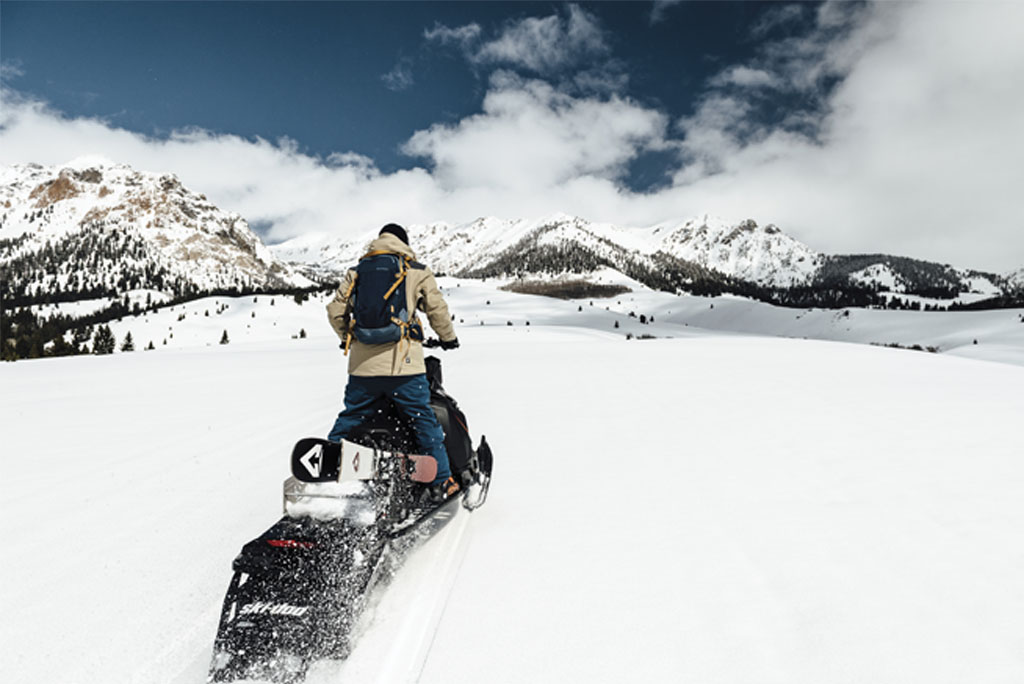
Andrew Edson used to drive through the middle of the Sawtooth Valley and dream of the lines you could ski. For years, they were just that—dreams. The problem wasn’t one of skill or willingness; Edson, a Sun Valley Ski Patroller who grew up in Twin Falls, spends all winter in ski boots. It was a problem of scale. It’d take Olympian legs and even then, multiple days to get back into those mountains, which seem to shy back a little further with each step forward you take.
That was until Edson found a little help.
These days, if Edson isn’t working on Baldy, he’s probably out exploring the backcountry from behind the handlebars of a snowmobile, finding the next great zone to ski. Edson is one in a growing cadre of sled skiers—devotees to an ascendent form of ski touring that blends motors and manpower to move faster, push deeper, and find more wild turns in the mountains around Sun Valley.
Ask around, and you’ll hear versions of Edson’s story all around the valley. What started on a borrowed “beater” sled grew into a winter obsession, blending two sports into one outing that’s as much about the drive in as the run down. This winter, there will be days their skis don’t leave the back of the sled—or even the back of the truck.
“There are a lot of people who bought sleds to ski and now they just snowmobile,” Edson said. “They don’t even bring their skis anymore. It’s just so fun.”

There’s no typical day sled skiing, but there are a few ways to do it. More experienced sledders will shuttle lines, almost like a chairlift. You’ll need at least two sleds and four people. First, pack in a route up the slope, and then alternate who skis and who drives down. That said, the difference between snowmobiling and skinning isn’t the difference between carrying your golf bag or taking a cart. Snowmachines take real skill to pilot, particularly on sidehills and in deep snow. They’re counterintuitive to steer, heavy and can go very fast, making them easy to drive into trouble and hard to get out. Most local sled skiers get into it from the ski side, and say snowmobiles take years to master.
With that in mind, the most common version of sled skiing might be more accurately called “snow machine-assisted ski touring,” because you’re still spending more time on the skin track, said Zach Crist, owner of Sun Valley Guides. That’s most of what Crist does with clients, using snowmobiles or side-by-sides fitted with tracks to haul gear, access huts or more generally push further up the Forest Service roads that splinter east and west off state State Highway 75. If a client wants and the snowpack cooperates, they’ll hop on to “provide a bit of extra adventure for those looking to go deeper into our remote terrain, away from crowds, up into higher thermoclines for better snow conditions.”
“It’s a massive backyard out there, and we have an abundance of public lands with plenty of motorized (and non-motorized) areas in mountainous terrain,” said Crist, a former member of the U.S. Ski Team, X-Games gold medalist and American Mountain Guides Association certified guide. “Sometimes we can net some extra vertical with the use of our machines, but there’s almost always some amount of hiking involved in a good day out.”
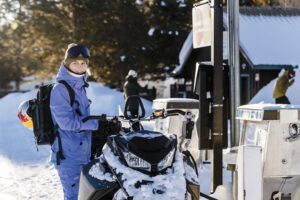 That’s how Graham Tyler got into it. On a warm-weather hike, he spotted a promising couloir above Baker Lake north of Ketchum. It looked skiable, and easy to get to—in the summer, when he could drive a smooth gravel road to a convenient trailhead. In the winter, with the road snowed in, the 30-minute drive turns into a 9.5-mile slog to the trailhead before you even start going up for another 3 or 4 miles. Then, you’d have to reverse course to get home. It’d end up close to a literal marathon, maybe a 25-mile day. So, he tried it on a snowmobile.
“I’m able to jump on my sled at 8 and be back at my car by 11, which is just incredible,” said Tyler, who is also a member of Sun Valley Ski Patrol. “The first winter I had it I went out there and did that and said, ‘Oh my god, this is awesome.’”
Now, he’ll cover 15 miles one way before he even clicks into his bindings. Before, that would be as big a day as he’d even consider.
“We’ll ride 20 miles up a basin, places where nobody can access,” Edson said. “You don’t see anyone else. If you do see people out there, you probably know them.”
Scott Savage, director of the Sawtooth Avalanche Center, is a snowmobiler, a backcountry skier and what he calls a “hybrid user”—the formal term for someone mixing both sports. Whether it’s work or play, he loves his sled.
“You get to see some amazing country on a snowmobile,” he said. “If you’re just skiing, unless you’re willing to spend a lot of time on approach, you’re limited to places a lot of other people have already been.
“It’s a scarcity thing,” he added. On a sled, “you can just drive out there and always find untracked snow.”
Sled skiers rarely give up their spots to strangers. Many go by pet names anyway. Edson’s partial to Goat Farm, named for a family of mountain goats that winters in the rocks. There’s a perfect 1,000-foot pitch out there, and shuttling sleds—two snowmobiles, four people—he can typically get six runs in an hour. You won’t find anything called Goat Farm on a map.
Finding zones “takes some figuring out,” Edson said. “I wouldn’t say it’s guarded, but I’ve always found that Ketchum is a place where, once you’re into the scene, people are willing to share. But if you’re not into the scene, people aren’t willing to share.”
Tyler scouts in the summer. He likes to hike and trail run, and he’ll get deep into the woods. Once there, he keeps his eyes open for ridges and lines to earmark for winter. There’s a treasure hunt aspect to it all, and that’s become part of the appeal. It’s a new way to appreciate the mountains he loves.
That doesn’t mean it’s for everyone. Just like a road cyclist may not enjoy riding dirt bikes, the skier who loves a predawn Baldy skin may not be into motorized help. Sleds are loud. They stink of burning oil, and they seem to either be broken all the time, or just break at the worst possible time.
On top of that, you’ll need to learn a new way to move in the backcountry—and that takes a different skillset.
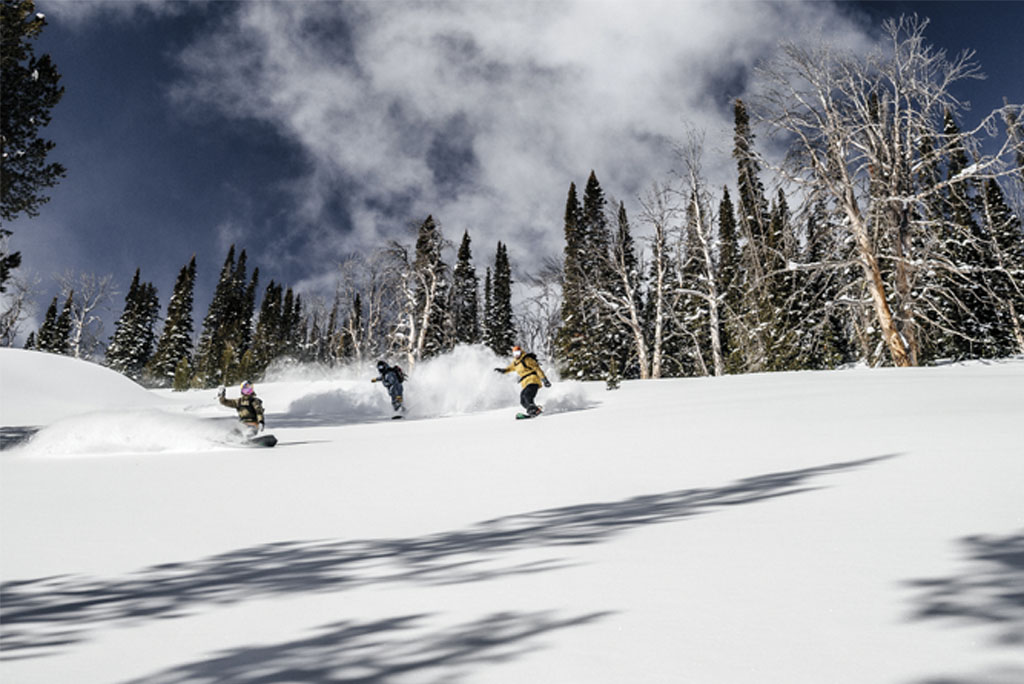
Apples to apples, a skier and snowmobile impact the snowpack about the same, because the machine spreads its weight over a larger area, said Savage, who has made a career in the study of snow. In practice, there aren’t many such like for like situations. At full throttle, a sled can dig several feet into the snow, and cover much, much more ground. The same thing that makes them so useful accessing the backcountry can make them more dangerous when they’re it. On a sled, you’ll impact exponentially more terrain.
“It’s kind of a numbers game,” he said. “Imagine you’re playing roulette, and one number triggers an avalanche. A skier is going to get one roll, maybe two. A snowmobile is going to roll 100 times.”
Recognizing changes in the snowpack can be harder, too. Sledders should wear dedicated snowmobiling helmets, which limits their field of vision; they’re on hundreds of pounds of rattling metal, so it’s harder to feel what’s under them; and they’re basically deaf to anything but the engine, blocking out the telltale “whumpf” of a collapsing layer. It might take 100 feet for a snowmobiler to react to a problem, Savage said; a seasoned skier sees, hears, and feels everything, and can turn around on the spot.
“You’re getting nothing like what you get on skis,” Savage said. “You don’t recognize how little you see or hear. It’s a different mindset: How do you get the information that things are unstable? It comes with experience.”
It’s like you’re reaching into different toolboxes to fix a problem, he said, “and when you’re starting out snowmobiling you don’t have any of the tools.”
Savage decides what he’s going to do in the backcountry before he heads out into the mountains. Anytime he’s taking a snowmobile, whether he’s skiing off it or not, he’ll always wear a dedicated snowmobile helmet, wear a radio and keep his avalanche gear—probe, beacon, shovel—on his back. If he plans on skiing, he’ll pack his ski helmet and swap at the slope.
“You need to treat it like you’re doing both sports,” he said. “There’s a reason snowmobile helmets are so big and heavy: because you’re going really fast on a huge piece of metal.”
Warnings aside, Savage believes snowmobiles can open new, safer routes to fun than backcountry skiing. When the snow is deep, and the mountains are shedding like snakes, you’ll usually find him on his sled flying through gentle fields near the floors of the Wood River and Sawtooth valleys.
“On scary days,” he said, “I’m a snowmobiler. “You don’t need to go into avalanche terrain to have fun. You can take avalanches out of the equation. Whereas, I know I’m not going to have fun walking around on flat ground.”
When possible, though, Savage is a hybrid user—a sled skier.
“They are very different, and when you combine them, it’s just a blast,” he said. “But there are days where I take my skis for a snowmobile ride—and it happens a lot more than I ever expected.”