


Lieutenant Colonel S. Kent Carnie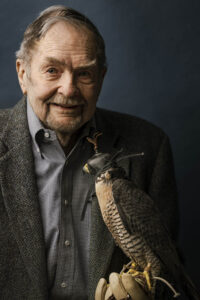
The Archives of Falconry, Founder | Falconer since 1960 (66 years)
Falconry is an incurable disease. It is not an interest. It’s not a hobby. It’s an obsession. People ask me, “what do you do?” And I say: “I’m a falconer … And in my spare time, I have a life.”
I was introduced to falconry at 10 years old, got my first bird when I was 14, and flew my last bird at 87 years old. I really “graduated” into the hard-core falconer status in 1960 when I began to take game regularly.
Falconry is a sport, but it’s a hunting sport. And … although it’s a hunting sport, the objective isn’t always to kill something. And we have a hard time making people understand this, but the whole reason that the falconer today flies a falcon is to watch that bird and its magnificent flight … the powers of its flight, and the speed and the heights that it reaches, and the stoops, and all this sort of thing. And the kill is incidental. But the falcon flies at its utmost when it’s hunting. And consequently, falconry is a hunting sport. So, if you are not actually hunting and taking game with a falcon, you’re not a falconer.
Well, I’ve had three things in my life that I wanted to do … or three things that I’m proud of doing. And one was establishing the Archives of Falconry—it was established by falconers, for falconers, to preserve the tangible history of falconry around the world. And I wrote a book on the history of falconry in the Western Hemisphere. And I’m pleased with that. I was working on it … I got a letter from Cornell Press in 1980. And we published the book in 2013. So, it took me a while. It’s a big book, though, with 500-plus pages and four editors. The other thing I’m proud of is that for a quarter century I have worked on the Technical Advisory Committee at NAFA in our national club, which was providing technical advice to falconers and administrators on falconry. And the first objective was just to get it legalized. And when we finally got it legalized basically with the feds, 17 states had adopted it. And when I stepped down from that job, 49 of the 50 states had it.
My last bird was a cross between a merlin and a gyrfalcon. It’s like crossing a dachshund and a great Dane. His name was Sport, but like any loved creature, he had lots of nicknames. He weighed about 13 ounces. He was a tiny, little thing. All heart, though, that bird. All heart.
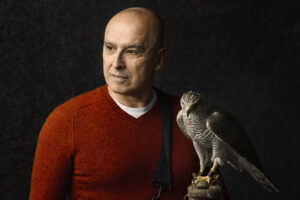 Afshin Mofid
Falconer since 2012 (14 years)
I was born in Tehran, Iran. And I came to the United States on a scholarship from Queen Farah of Iran to come to study ballet in New York. And so, I had a whole career with the New York City Ballet for about seven years. Then, later, when I came to Idaho, I said: I love this place.
As a boy growing up in Iran, I would read about falconry, especially in the 19th century literature or diaries of kings and aristocrats that would talk about falconry. And I was obsessed, so as a kid of 8 or 9, I would ask my grandfather about it because he was a hunter. We were all hunters. But I would always get the same answer, that, “Oh, that’s something that we used to do, but we don’t know anybody that does that anymore.”
I didn’t find out the reason for this until many, many years later. In the early 20th century, there was a big movement in all levels of Iranian society towards modernization and people looked at falconry as a relic of the past, something people did in the old times. There were actually laws passed in the 1920s that forbade people from keeping birds—people could not keep pigeons.
So, falconry quietly disappeared from Iran, a country where it originated. I think it traces back to World War II when the Allies occupied the country. They left. But when they left, they left behind guns, jeeps, all this military equipment. Suddenly people had access to semi-automatic shotguns and rifles, and hunting became easier—more immediate. Shooting took over and became so popular that people just forgot about anything that was traditional. And that’s why as a kid, when I would go hunting with my grandfather and kept asking about these birds, nobody could answer me.
When I moved to Idaho in 2000, I began asking again. And then I realized that Idaho is the place all these falconers want to be. Idaho is home to all these public lands and the Archives of Falconry. There is even an Iranian book on falconry that was written almost 300 years ago, and the only copy in the country is right here in Boise at the Archives of Falconry.
My turning point came outside Howe, Idaho. I was scouting with an antelope permit. I was just driving around and drove past a house in the middle of nowhere with a falcon on a block out front. So, I stopped the car. I ran out. And it turned out to be a falconer by the name of Jack Orr. I didn’t know who he was. But I saw his birds, so we started talking. And he took me out hawking with his gyr-peregrine. And we caught a couple of sage grouse around his house. And later, I shot an antelope. And then I gave him half the antelope. And I put my tent up and stayed in their yard for two nights just to be around those birds.
Soon after, I looked into falconry and became an apprentice. You have to take a test with Idaho Fish and Game, then find a sponsor and complete a two-year apprenticeship. It’s a great system, designed with care by people like Kent Carnie, who helped set the rules and regulations.
To me falconry is about the challenge of putting away a gun, which is easy to get something with. And, in its place, you are really focused on developing this bird like an athlete. Because the birds are hunters. So, I relate to them. They hunt, and I hunt. And they’re much, much better hunters than we are, because they’ve developed it over millions of years.
You’ve got to be a patient person. This is a living thing you’re working with. But it truly is the best way you can hang out with this bird and experience what they do in nature. It’s kind of like being in National Geographic. You get to see them do what they do in nature, what they do in the wild—and it’s such a privilege to be able to see that up front.
Charles Browning
Falconer since 1969 (57 years)
I got my beginners falconer’s license at 15 years old. I eventually became a farrier, and in 1977 I picked up and moved to Idaho, because I had done my research and found it was one of the best places to fly birds. My life has pretty much revolved around falconry ever since. I have three birds: two are gyrfalcon-peregrine hybrids and one is a gyrfalcon with a little saker falcon mixed in.
Falconry is one of the coolest forms of hunting. It’s very intertwined with the dog and the bird and the partnership between the two of them. And you just get to see things that nobody else gets to see in the natural world, pretty much, on a regular basis. It’s the way the raptor flies, but it’s also the quarry and the interaction between them and all the cool stuff that the quarry does that a gun hunter would never get to see. Nothing against gun hunting, but the difference between being chased by a falcon and being shot at is night and day. You know it when you see it. Sometimes when I’m talking to a hunter, they’ll say something like, “Once we were out duck hunting and, out of nowhere, this falcon came in and attacked one of the ducks right in front of us… it was the coolest thing we’ve ever seen.” And my response is just: there you go. That’s what I get to do every time.
As a sport, falconry is an exercise in self-restraint and dedication and patience. It demands a lot of you personally. It’s a daily thing and everything else revolves around making the time. For me, falconry is something to live for … A lot of people don’t have that.
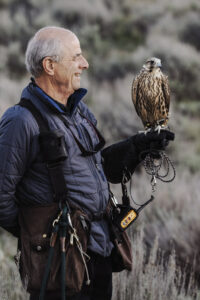 Jeff King, DVM
Falconer since 1975 (51 years)
I always say that “I didn’t choose falconry, it chose me.” … When I was 16 years old, I was living in California and rode to the coast with a friend of mine who was delivering a Bentley he had done some restoration work on. I didn’t have a driver’s license at the time, and, as we were walking in to deliver the keys, I saw a falcon on a block perch in front of a condo. I was immediately attracted to it, to the point that when my friend said, “It’s time to go,” I said, “No, I just talked to the cleaning lady, and I’m waiting for the owner to come home to find out what this is all about.” So, I sat down cross-legged on the grass for a couple hours before the owner came back and explained that he was a falconer. He was a corporate pilot and had acquired the bird from the Middle East. That was the beginning of my fascination with raptors, which grew over the years by combing the local libraries to read anything about falconry.
While I was at UC Davis getting my degrees in wildlife and avian sciences, I was working at the Raptor Center and realized that all the techniques we were using for rehabbing birds were adapted from the art and sport of falconry … So, for me, my entry into the sport really all started from conservation. After becoming licensed and practicing as a falconer in California, I moved to Southern Idaho so I could specialize in gyrfalcons because it offered some of best habitat and quarry—the sage grouse—for my birds, the largest and most powerful falcon species on Earth.
Falconry keeps me centered. I like to tell people that falconry is a very specialized form of bird watching. It’s a way of life. You need to have the passion for i, because you have to be willing to give up other things in order to care properly for the birds. And you also must have the ability to think outside of yourself to facilitate a great working relationship. My mantra, which I didn’t originate, a very good falconer friend of my coined the phrase: When you’re interacting with other sentient beings, it doesn’t really matter what I think, what really matters is what they think. In other words, you’ve got to know their needs and motivation so you can determine what endears them to you; or at least, create some level of fidelity so that they want to cooperatively hunt with you and your pointing dog.
Darryl Barnes, MS, PA-C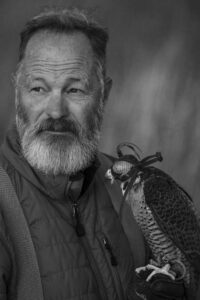
President, Idaho Falconers Association | Falconer since 1982 (44 years)
The first time I saw a falcon was when I was 7 years old and saw someone with a kestrel on the glove at the New England states annual fair. There weren’t any falconers where I lived in Connecticut, so I just read everything I could … at the school library, the city library, the Natural History Museum. Then I saw an article in an outdoor hunting magazine with an interview about Heinz Meng, a pretty well-known falconer in New York (also one of America’s leading ornithologists). I was probably only 10 years old at the time, but I wrote him a letter asking about falconry, and he actually wrote me back. That was it for me. I was living in Massachusetts.
Technically speaking, if you are not using a raptor to hunt and chase quarry, then it is not truly falconry. You don’t train a bird to do that, evolution has done it. Essentially, we provide the opportunity and then try to get out of the way. What we’re really trying to do is allow the birds to behave as they would in the wild. It’s best for both the raptor and the falconer for the bird to be as close as possible, mentally and physically, to a wild raptor.
I’m thinking of a particular flight on a large triangular pond this season with “Rojo,” a tiercel [male] peregrine falcon I bred here at home. With GPS telemetry technology, we are able to record flights in real time. This particular flight was 31 minutes long. He had two stoops in excess of 120 miles an hour, both over 2,500 feet. That’s a half a mile up … and at about 1,200 feet, even if you’re staring at them, they just vaporize. His max altitude for that flight was 2,785 feet, well out of sight to the naked eye.
For me, the realization is that when practicing falconry, I am not an observer, I am part of the experience; not an observer of nature, but a part of nature. The reality is we already are, everybody is, but we don’t really think of it in those terms every day. But when you go out and you fly birds, it reminds you. It puts you in that moment.