

Milton and Vernette Haar believed in the things they saw, just as they believed in the things they didn’t.
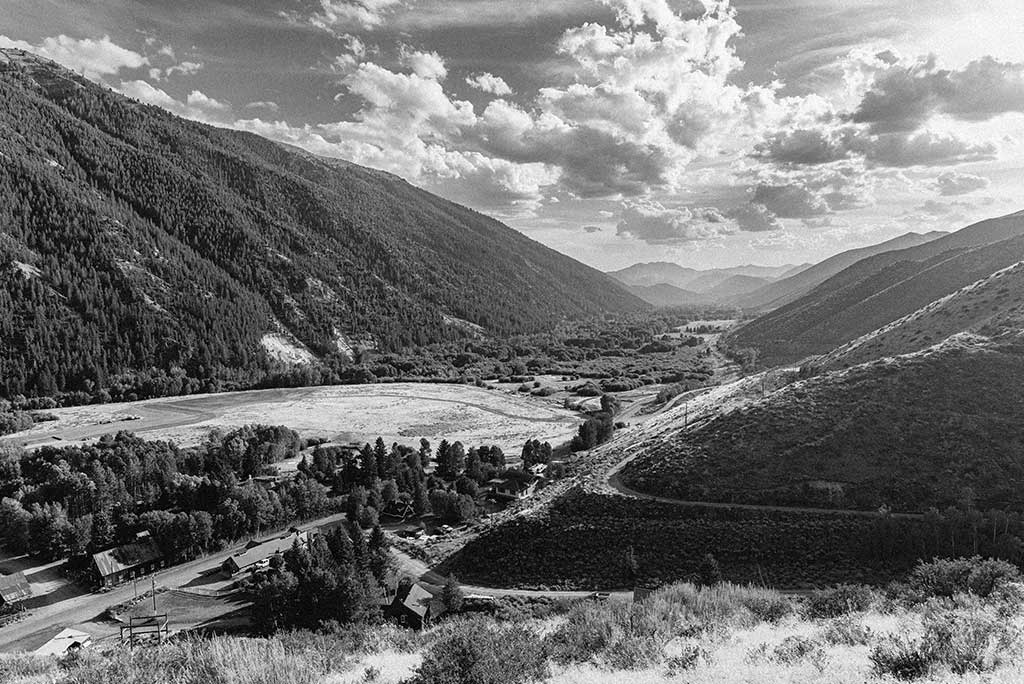
The New Age minister and the clairvoyant minister’s wife found both in the one-time mining town of Triumph, Idaho, during the early 1960s—though found isn’t the word they would have chosen. The Haars told reporters across the decades that they were led to Triumph from their home in Gettysburg, South Dakota, to establish what has alternately been described as a “commune,” a “hippie establishment” a “religious retreat” and a “UFO cult” in the thin canyon carved by the East Fork of the Big Wood River.
To Ashton and Alaina Wilson, Triumph is just called “home.”
The Wilsons moved from Ketchum to Triumph about seven years ago, before the birth of their son, Ernie. That makes them short timers in the unincorporated community of about 60 a 12-mile drive from Hailey, where a clutch of neighbors have lived since the Ford Administration, if not before.
The town, such as it is, starts out East Fork Road around the time most texts stop going through, and for that it already earns an old-fashioned feel. It’s a late stronghold of the landline, and residents are often unreachable unless you walk right up and knock on the door. It makes the place tight-knit, one resident said. She was hesitant to speak to a reporter, except to say what “a wonderful, quaint and peaceful community Triumph is with a rich historical background.” She’d lived there, I’d learn, some 50 years.
Billy and Wendy Collins have lived here 51 years. The couple lived in the house that’s now Grumpy’s on Warm Springs Road before striking out for greener pastures, quite literally; for their horses.
“I hardly see my neighbors,” Billy said recently, “but if something happens, they’re there. That’s how it always seems to operate out here. It’s really a nice thing.”

Gardner, Eve, and Bowen Cord.
If the Collinses are Triumph’s old guard, the Wilsons are part of a new generation who found the neighborhood in search of the same things as their tenured peers: More space, less commotion, and a price they could afford to pay.
On that criteria, few in the shadow of Sun Valley made out as well as Milton and Vernette Haar. Answering their calling, the Haars spent $50,000 in 1962 to purchase a rough 90 acres and 17 buildings — essentially what’s now the townsite of Triumph — from the Triumph Mine Company, according to a 1975 report in the Twin Falls Times News. That’s worth about $552,000 today, less than half of Blaine County’s median listing price for a single house. The New Agers had stumbled into the tail end of Blaine County’s mining economy, and made out pretty well. The Triumph Mine, a web of claims tucked in tunnels under the hillsides around town, had been one of the region’s richest. From 1884 until 1959, it turned out $39 million in metals, mostly zinc, silver and lead, according to research from The Community Library. Depending on your source, 150 to 200 men dug into these mountains in the early half of the 20th Century, pulling ore for the Philadelphia Smelter in Ketchum and places far beyond. World War II stoked a flare up in activity, but soon after mining at that scale wound down for good, and the earthworks—alongside its mineral rights—were sold to the mine’s foreman, Rupert House.
The Houses and the Haars lived for a long time as strange, if cordial neighbors. Rupert House started mining at 17. He was a Golden Gloves boxing champ, founder of the Sawtooth Rangers Riding Club, and, later, a Blaine County commissioner.
Vernette Haar could, through meditation and automatic writing, contact a higher being named St. Germain.
The Haars practiced daily meditation and spoke morning affirmations: “Nothing but good shall come to me, nothing but good shall go from me,” Milton would say. They believed in aliens, and saw them with some regularity in the skies around Triumph. Milton Haar and a retired Air Force major named Wayne Aho lectured on the subject. They held an annual conference on the subject in Ketchum, and took their material on tour. Had you been in the Blue Room of the Owyhee Hotel in March of 1962, you could have caught their three-day seminar, sponsored by a California firm named Understanding International. Topics were titled “Unidentified Flying Objects (Spaceships) in Earth Skies,” “The Ending of the Old Age and the Dawning of the New Age,” and “Survival in the Atomic Age.” The Rocky Mountain area, the Haars told a reporter in 1975, “has higher vibration, making it easier to communicate with alien beings.” But when the Collinses moved in, most of the Haars’ original troupe had moved on, replaced by younger pilgrims with their own beliefs.
“Each seems to be on their own thing,” the Haars told the reporter in 1975.
“Many of our young people are great souls,” Haar, a former Protestant preacher, said. “They have come here to find themselves, but many do not know how to express themselves because of the great confusion in the world.
“There might be some that use marijuana, but we feel more and more they are getting away from that.”
Rupert House didn’t seem to mind the company, which he said kept “pretty well to themselves.”
“A lot of people say they’re hippies, but I say, ‘What the hell is a hippie?’” he told the reporter. Most of them work. Several of them are buying their houses. They are different from those of us who are members of the establishment, but I’m slightly envious.”
House had seen plenty of change in that establishment himself. Rupert House was born on the first day of spring in Hansen, Idaho, east of Twin Falls. He moved to the Wood River Valley 20 years later.
“These gals said that things were looking up in Blaine County,” House told the Idaho Mountain Express in 2006, two years before his death. “They said the Triumph Mine was up and running again, and some railroad people were building a fancy hotel near Ketchum.”
House signed on at the North Star Mine in Triumph for three dollars a day, less one for room and board. To that point, he’d never seen a dollar bill—and wouldn’t for another two years. Even then, he thought it was a fad: “That stuff will never last,” he’d said. Later that year, the hotel those gals had mentioned would be christened the Sun Valley Lodge, and America’s first destination ski resort would open on the slopes of Proctor Mountain.
House moved his family to Triumph full time in 1949. He stayed on until the bitter end, then kept digging.
“My wife says she’ll live any place in the world,” he told the Times-News, in 1975, “as long as it’s here.”
House tried to revive the Triumph claims into the 1980s, but it never came back like it did during the war. When the Age of Aquarius found their little canyon, Rupert and Bonnie House were running cattle and raising their family in a “shack-like home” made of salvaged timber past “the camp,” as they called Triumph, friend and resident Carl Massaro wrote in his book, “My Years in Triumph: A Search for the Lost Utopia.”
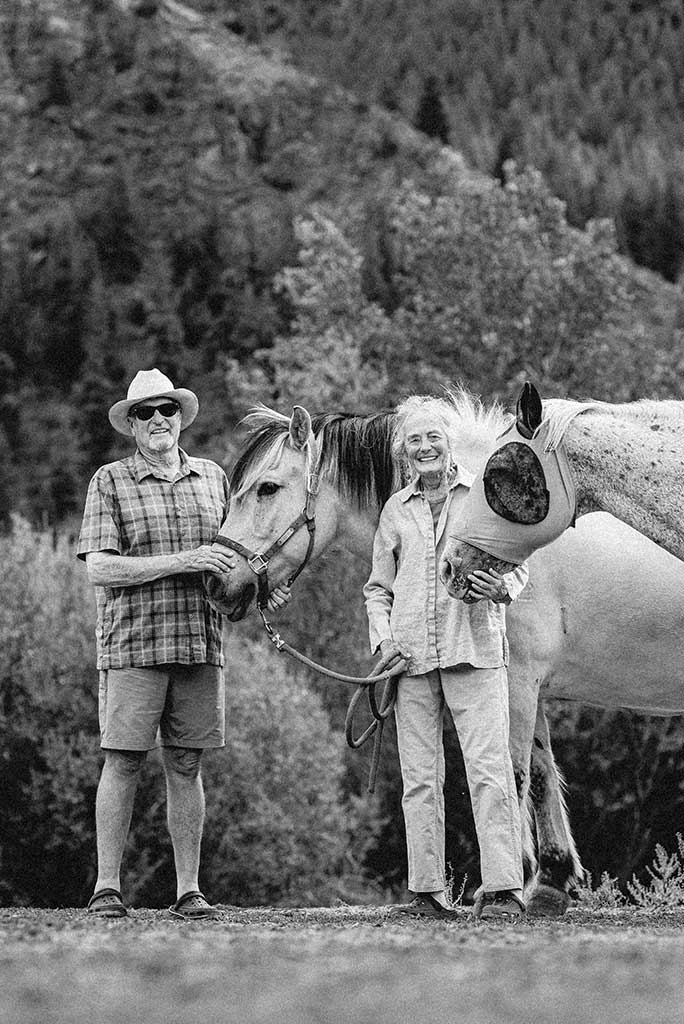
Billy and Wendy Collins
“It was said that if you wanted to talk to Rupe, bring your hammer,” Massaro wrote. “His wife, Bonnie, would feed ya, but he would work ya.”
Nearby, “the camp” was taking on the increasingly odd shape of a town. The Haars and their followers lived in a cluster of old mine shelters and built small houses as they found the time. Milton Haar sold them for six or seven thousand dollars “to anyone who came along, no questions, no credit application.” Massaro himself built a house shaped like a pyramid, where he lived for years.
By multiple accounts, Milton Haar was aware of his reputation, and knew the reputation of the town he helped grow. One day, a group had gathered at the Massaros’ house when the county building inspector drove up.
“Who’s building this,” Massaro and Triumph resident Billy Collins remembers the man asking.
“Why, men from space,” Milton Haar answered. Collins remembers the inspector’s stunned face. “They come in the night and work with lamps.”
The county man turned around.
‘Milton, why did you say that?’” Collins asked when the building inspector had gone.
“Well,” Haar said, “we’re all from space.”
“See,” Collins told me in August, “he always played that card.”
In Triumph, stories like that are less about the truth and more about the telling. Milton Haar had a sense of humor, Massaro said. He also had sincere beliefs, and saw UFOs all the time. Those two traits make facts hard to parse. Consider this: his brother, Ernie, was building a great wooden structure near the town’s main barn. Massaro remembers it as a go-kart track. Collins told me it was a roller coaster. Wilson, who was told the story second (or third) hand, heard it was a scaffold to help Jesus land his rocket when he came back down from the stars.
“I love that there is lore here,” Wilson said. When he hears a new story, he always tries to keep it in his back pocket. If he runs into a longtime resident—someone like Collins—he’ll ask to hear about it. He rarely gets the same version twice.
“No one is ever like, ‘Yeah, for sure, that’s exactly how it went,” Wilson said. “Everyone has their own story, which is awesome.”
Like the time Haar greeted Collins with a grim warning.
“Well, they’re here to get us,” he said.
“What do you mean, Milton?”
“Yeah, they’re here to get us and there they are,” Haar said, pointing.
Collins turned and his hair stood on end—before he realized he was looking at the round crest of a hot air balloon coming over the ridge.

Ashton and Ernie Wilson
People don’t talk about the UFOs that much anymore, Collins said. There are so few people in Ketchum and Hailey that remember Haar and how that talk got started. Collins used to have people come up to his door and ask if he’s seen anything in the sky overhead. He’d play into the bit, whether the visitors knew he was or not.
“What type, the circular ones or the cigar shaped ones?” Collins would say.
“Where do you see them?”
“Well,” he’d point, “go up the canyon about 16 miles and wait.”
The Collinses own children were more likely to be waiting for the school bus, back when it came, standing in the snow next to Olympic ski racer and gold metalist, Picabo Street, Triumph’s own.
Wilson, the executive director of the Environmental Resource Center in Ketchum, keeps a scientific skepticism on the subject.
“The universe is far too vast for there not to be other life out there,” he said, summoning his inner Neil deGrasse Tyson. “But the odds that it touched down in Triumph are significantly less than the volume of hallucinogens that flowed through this town in the ‘60s and ‘70s.
“I think brain chemistry is easier to modify than the space time continuum.”
So no, Wilson doesn’t see saucers from his porch. But in a way, he can see a vision of the future. Billy and Wendy Collins have lived on the same road since 1975. They arrived to find a small town of like-minded young people, and a few older ones — like Milton and Vernette Haar. Some died, others left, still more stayed behind. They married, divorced, had kids and cried in driveways when those kids went away to college or beyond. Several families that arrived in the 70s are still in the same houses, in a small town that looks, at first glance, very much the same now as then. They’re like-minded old people now, rather than young.
“You can still walk down the street and borrow a cup of sugar,” Wilson said. “If someone gets sick, everyone’s asking how they could chip in to help. Sometimes you get a little too on each other’s toes, and you take a breather, but for the most part it’s cordial — roaming dogs and roaming people.”
Today, to the Collinses, it feels like there’s a broader range of people in town. Their son and grandson live next door. And in the past year or so, they’ve all welcomed two new babies into the valley. At a few months old, Bowen Cord is a seventh-generation Idahoan and “a first-generation Triumphite,” his father, Gardner, told me.
Gardner Cord spent his 20’s following the standard Ketchum playbook: frequent moves and plenty of roommates.
“It was a lot of fun, but after I moved like the fourth time in three years, I was over it.”
He set out looking for a permanent place with a few competing criteria: a garage, a yard and a price tag he could stomach. Growing up in the Wood River Valley, Cord always thought he might move out East Fork “when I really made it.” Still, he drove past the eight-figure estates that dot the road up the canyon to find a little lot in Triumph that needed some love, but somehow fit his budget.
“The house was a little bit funky,” he said. “I did some remodels. And we have done, like, one quick seance to cleanse some spirits. Since then, it’s been great.”
The harder part was convincing his then girlfriend, Eve, to come with him. Her response: a flat “no.”
“Maybe when I’m 30,” Eve Pruecil — now Eve Cord — said at the time.
Gardner had the place for about two years before Eve made the leap and moved in. Now, like Bonnie House before her, “she refuses to live anywhere else,” Gardner said.
Eve Cord has learned to appreciate the silence — the bird calls, the bears, the signs of life that make every day “like a safari,” she said. And she’s come to love the moment when it all comes into view: East Fork Road bends and Hyndman Peak tops out overhead, leading the Pioneer Mountains toward the sky.
“It’s the most peaceful homecoming,”
she said, “Like a ‘Welcome Home’ sign I see every day.”

Remnants of the mining era are sprinkled throughout Triumph.
For the first three months, the house didn’t have high-speed internet or cell service. Starlink has been a game changer for many residents — the Cords and Wilsons included — but those first three months were probably some of the best, Gardner said. Send your texts at the mouth of East Fork Road and get your responses the next day.
Their household already fits the Triumph mold: Gardner is content to do his own thing, while Eve’s happy to stop and chat as she takes the dogs up and down the street. They’re yet to see anything out-of-this-world, Eve said, but it’s on her mind.
“Whenever Gardner’s out of town and I’m walking the dogs at night, I think that they might just abduct me in that moment,” she laughed. “He’d never know where I went, because I will just vanish off the face of the Earth.
“Now that I’m thinking about them they will definitely abduct me — they know that I know they’re there.”
Choosing to raise Bowen in Triumph, their concerns lay under the ground rather than above it.
In 1993, the Environmental Protection Agency proposed listing Triumph as a Superfund site, contaminated with heavy metals left by the mine. Local opposition to the designation led to state-run remediation. The Idaho Department of Environmental Quality started its own clean-up in 1998, with major work generally ending in 2004. It is still under state supervision, subject to regular inspection, monitoring and five–year reviews. Much of the neighborhood is reluctant to talk on the record about it, though Garnder Cord said it was a “major consideration” in his move. What he has found since put him at ease. The Cords independently tested water from their faucets and from the community well, and checked the DEQ’s finding on sites around the town. Everything nearby — particularly the water — came back clean.
“You know there are contaminants around, but over the past almost 30 years it seems like they’ve done a really good job.”
Gardner’s cousins, who are soon following the Cords to Triumph, shared his initial concerns. He pointed to the neighbors.
“I mean, look at every person who has lived here for the last 50 years,” he said. “They’re all happy. They’re all healthy. That was my real sign.”
The Cords now live a five minute walk from the Wilsons. Esther Wilson, their daughter, isn’t that much older than Bowen Cord.
“I feel super fortunate to have this close-knit neighborhood; all these folks, we’ve become friends,” he said. “You’re growing in life alongside these people. You get to see the days and seasons pass with a bit of a village. We’re pretty lucky.”
As we talked, a neighbor knocked on the door and asked if Ernie wanted to watch a rainbow blooming overhead. Soon, the sun would run below the ridgeline and the animals would grow a little louder, Sandhill cranes and great horned owls and the yip of coyotes welcoming the night. And before he puts his kids to bed, Wilson could look up into that perfect August dark, same as Milton Haar, and see, if not spaceships, then stars, countless stars.