


Levi Smiley and T.B. Mulkey made a good team. By all historical accounts, they were hardy men who were well-conditioned to the profound rigors of exploring the rugged central Idaho mountains with pick and shovel in search of gold and silver ore. And though neither had unearthed the Mother Lode during their prior explorations, their fates were fundamentally altered on a hot summer day in 1878 at the northern foot of Galena Summit, an imposing mountain pass some 30 miles north of modern-day Sun Valley, Idaho.
The grizzled prospectors panned their way up a small tributary among the headwaters of the Upper Salmon River, often referred to as Idaho’s River of No Return due to the at-the-time unnavigable rapids farther downriver. Near the emergence of spring water from the uppermost bedrock reaches of the creek, a shimmering reflection caught their attention, and upon further inspection, a significant quartz lode was identified, a sure sign of color, a term commonly used to refer to gold and silver ore. Outcries of “Eureka!” may very well have echoed down the valley of what has been known as Smiley Creek from that long-ago day until nearly 150 years later.
But their meaningful discovery was not to be developed without delay. In those early days of European exploration and settlement, Native American tribes, including the Bannock, Shoshone, and Tukudeka tribes, still circulated in the wilder reaches of central Idaho. Most Native Americans of that era had been corralled or were in the process of being moved to reservations where they were displaced from their traditional lands, yet some still roamed the area.
 As a result, relations between settlers and natives were reaching boiling points in several regional locales. In 1878, within weeks of Smiley and Mulkey’s discovery, the Bannock War broke out on the Camas Prairie, 40 miles south. As a result, local prospectors immediately closed up shop and hustled back to the relative safety of Challis, approximately 50 miles to the northeast, only to return the following spring to resume their prospecting.
Once the Bannock War had been quelled and prospectors returned, ore production exploded in the upper Sawtooth Valley. Several mining companies, such as the Colombia and Beaver Mining Company, constructed mills and the necessary infrastructure to extract gold, silver, lead, zinc and tungsten at a frenetic pace, often putting basic safety considerations on the back burner, which led to numerous accidents and kept the local graveyard population growing at a steady rate.
One of two primary mining camps, Sawtooth City was established in 1879 on the banks of Beaver Creek. By its peak in 1882, it boasted a population of approximately 600 residents and two dozen log-hewn homes, two hotels, three restaurants, four saloons, a general merchandising store, a blacksmith shop, a laundry, an assay office and a post office.
 In addition to Sawtooth City, a sister camp in the head of Smiley Creek was constructed and named Vienna (pronounced Vy-ee-na), the town that serviced the Vienna mine. At its zenith, Vienna consisted of 250 buildings, including 14 saloons, six restaurants, three general stores, a Chinese laundry, and a blacksmith shop. Like so many of the boom-or-bust mining communities of the American West, the shelf life of both Sawtooth City and Vienna was relatively short, and both bustling populations had completely deserted by the winter of 1888.
Today, Smiley Creek not only serves as the moniker attributed to the high mountain stream which was home to Vienna and the Vienna mine but is also the colloquial term assigned to the small community of Sawtooth City, a community of approximately 70 mostly part-time residents who reside in this idyllic Rocky Mountain hamlet in northern Blaine County.
Smiley Creek Lodge—the roadside restaurant, store, and gas station—that currently serves the residents of Sawtooth City and the thousands of tourists who visit annually, was built in the mid-1950s by Louise and Maurice Bevins to address growing tourism due to the newly paved and redirected road, which spanned from Ketchum northward to Stanley. Prior to the construction of the lodge, the land had been owned by Leroy and Ona Vader, Louise Bevins’s parents. It had served as the ranching headquarters of the Salmon Falls Sheep Company.
In 1970, the establishment of the Sawtooth National Recreation Area threatened potential eviction of private landowners within the proposed SNRA boundaries due to claims of Eminent Domain. In response, Sawtooth City homeowners employed a lawyer to represent their interests. They convinced the U.S. Congress to approve Sawtooth City as a “designated community” within the SNRA along with Stanley and Lower Stanley, situated 20-some miles downstream. Through this effort, the community officially and legally adopted the township name Sawtooth City.
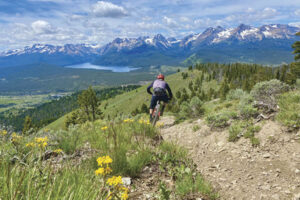 Modern visitors to Sawtooth City often stop by Smiley Creek Lodge for a tank of gas, a signature huckleberry milkshake or a delicious meal served in the lodge’s dining room. Recreational rentals such as XUVs, mountain bikes, standup paddleboards in the summer, and snowmobiles in the winter make for exciting and fun mountain adventure options for visitors from across the United States and even further abroad.
Occasionally, music concerts are held in the meadows nearby. Groups of aviators regularly descend and camp on the grass airstrip across state Highway 75, coming together to celebrate Idaho’s significant backcountry aviation history and culture. Access roads to Alturas, Pettit, and Redfish lakes are a short drive from Sawtooth City, allowing recreationists to access more than 300 alpine lakes on many trail systems that offer world-class hiking, backpacking, mountain biking and horseback experiences.
Today, Sawtooth City, still referred to as Smiley Creek by most locals from the Sawtooth and adjacent Wood River Valley, stands not only as a storied community and hub of recreation in one of the most scenic and majestic Rocky Mountain landscapes but also serves as a reminder of the rugged and rife pioneer history of the many men and women that ventured into the wilds of central Idaho in search of gold and a ruggedly individualistic lifestyle more than a century and a half ago.