

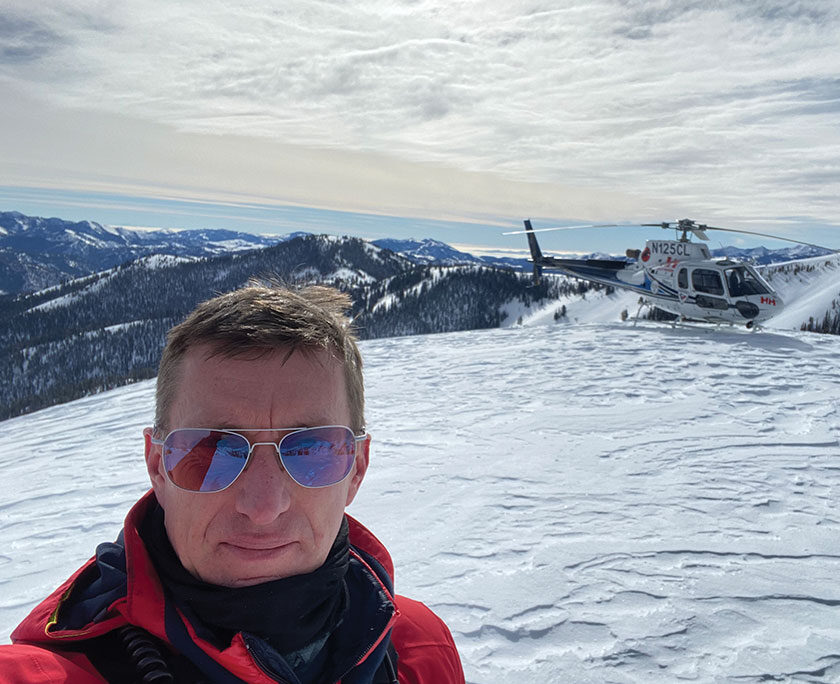
As a kid, Chris Templeton would sit outside his Venice Beach home and watch the planes line up on approach to LAX. On special days, he’d go to the Santa Monica Airport, which doubled as a museum, and see it all up close. He knew then, as now, that he was born to fly.
In the years in between, he’s simply reconsidered how.
Templeton flies helicopters. He flies over fire and ice; contracting with a crew during wildfire season and with Sun Valley Ski during the winter months. The environment differs, sure, but Templeton’s approach, and the precision he brings to the cockpit, hasn’t wavered in some 25 years on the job. Neither does the challenge. And, whether he’s hovering over a flaming forest, or landing on a faceted cornice, for Templeton, the challenge is the draw.
Templeton took his first helicopter flight in college. He knew that he wanted to pilot one professionally while they were still in the air.
“It’s just the freedom,” he said. “The missions you’re doing—it’s just so different from flying an airplane. It’s sort of indescribable. You’re still flying people from Point A to Point B, but it isn’t airport to airport. It’s some teeny, little spot on a ridgetop somewhere to deliver firefighters for a rescue.”
Templeton may do as many landings in a year as a commercial airline pilot does in a decade. He estimates some 300 on fires each summer followed by 2,000 in a ski season. Sun Valley Heli Ski operates on the largest permit in the lower 48—750,000 square acres, almost the size of Rhode Island—meaning Templeton keeps a couple hundred landing zones in his head all winter. His goal each time: plus or minus three inches.
“I’ve seen Chris land all day at the same [landing zone],” said Alex Kittrell, owner and guide at Sun Valley Heli Ski. “At the end of it, there’s just one set of tracks in the snow, and he’s landed there 10 times.”
I met Templeton near his home in Hailey last fall. His house, for most of the year, is his “expensive storage unit,” a place he stops to swap gear and head out again. But now fire season had ended and so had the months of hotel rooms on the road.
In conversation, he’s soft-spoken and precise. He relishes the technical details of flight, and the terms of the craft: “torque effect,” “gyroscopic procession,” “pendular action”—“all the physics you’re overcoming,” he says. Templeton terms it “cerebral,” but describes it more like art.
Consider a hover. Both hands, both feet in concert, making small moves and anticipating an opposite and far-from-equal reaction. He leads, the machine follows. Fred Astaire and Ginger Rodgers, hanging midair over a flaming forest, a snow-wrapped cliff. Mistakes get amplified with every rotation, and success looks like nothing at all—or, rather, like magic: all that horsepower, all that metal, whirling in pursuit of perfect stillness, suspended from the top of the sky.
“You’re never going to learn to fly a helicopter watching somebody that knows how, because the controls move so little,” he said. “I can still remember trying to learn to fly a helicopter and thinking, ‘This is never going to happen. The helicopter seems to have a mind of its own. You’re sitting there, and whatever you do is wrong.”
Since 2001, Templeton has made it his career to take that challenge and then amplify it with each new skill. He first noticed helitack crews at work from above, flying a news chopper covering Southern California wildfires. He decided that was next. He saw his first short haul while on a fire in New Mexico, and that became the goal. Short haul is a benign name for a perilous task: Flying personnel—firefighters, EMS, injured patients—at the end of a rope dangling below the aircraft. It’s used to get people to places even a helicopter can’t land, and for civilian pilots it’s about the most challenging thing you can do in the cockpit. To qualify to fly it, each year Templeton must show that he can lower a load off a 150-foot line into a 10-foot cylinder. In practice, he’ll have to guide a much longer line—sometimes twice that length—into the palm of a rescuer’s hand. Short haul, he says, is “the pinnacle.”
“You really can’t afford to get it wrong,” he said. “You have a human at the end of the line.”
Whatever the next challenge is, Templeton plans to find it in the cockpit. He’s never had a plan that didn’t involve the air.
“My entire life I envisioned myself as a pilot,” he said. “I didn’t have a plan—first I would do this, then this, and end my career doing this. I just never said no to a new opportunity to gain a new skill, or a new experience. And that opens up more opportunities. Whenever someone asked, ‘Hey, do you want to try this?’ I always said, ‘yes.’”
“Templeton loves flying helicopters,” Kittrell said. “Most heliski pilots like it. Templeton loves flying so much that he gets grumpy when we have a day off. He’s one of the best.”