

Looking for somewhere strange and fascinating to go for a day trip? How about visiting the Moon without leaving Earth?
Less than an hour’s drive from the Wood River Valley sits the surreal Craters of the Moon National Monument and Preserve, where one might temporarily imagine they’ve landed on the lunar surface. It’s a place of lava flows, volcanic cinder cones, dark caves, and eerie quiet.
History of Craters of the Moon
The landscape of Craters of the Moon was formed through eight major eruptions over the past 15,000 years, the most recent one occurring about 2,000 years ago. Lava spewed from the Great Rift, a series of deep cracks that stretch 52 miles on Idaho’s Snake River Plain. Over the millennia, the lava field grew to cover 618 square miles. The Great Rift is the deepest land-based open volcanic rift in the world and one of the longest volcanic rifts in the Continental United States.
For thousands of years, the indigenous Shoshone-Bannock people traversed the lava flows during their annual hunting and fishing journeys across Southern Idaho, as evidenced by unearthed archaeological artifacts, including pottery, arrowheads, and tools dating back 12,000 to 14,000 years.
The site was little known to the public until the 1920s when Boisean Robert Limbert completed a 17-day, 80-mile journey through the volcanic wilderness and published an account of his grueling expedition titled “Among the Craters of the Moon” in National Geographic magazine. It was Limbert who urged then-President Calvin Coolidge to protect the extraordinary area. Coolidge issued a 1924 proclamation establishing Craters of the Moon National Monument and wrote, “This area contains many curious and unusual phenomena of great educational value, and has a weird and scenic landscape peculiar to itself.”
Where to Begin
The Robert Limbert Visitor Center at Craters of the Moon National Monument and Preserve is a key starting point where one can get food and drinks, books, souvenirs, maps, use restrooms, and obtain free permits required for cave exploration. Right near the visitor center is the Lava Flow Campground, a 42-site campground accessible by automobile from May through November, depending on snow conditions. All sites are available on a first-come, first-served basis.
Exploring the Lava Structures
Visitors can take a leisurely drive through the lava fields on the 9-mile Loop Road, then may choose to climb to the summits of cinder cones and explore the cool underground lava tube caves.
The Blue Dragon lava flow is one of the most striking and visually unique lava flows in Craters of the Moon. Known for its iridescent, bluish sheen, it’s a type of pāhoehoe lava (a smooth, ropy basaltic lava), which can change appearance under certain lighting conditions.
Enjoy a short stroll through cinder beds and the native vegetation of Devils Orchard trail. This paved half-mile trail is wheelchair accessible and takes visitors through an area of cinder beds scattered with lava fragments.
Cinder cones and spatter cones are highlights of the park. Cinder cones are prominent hills formed from piles of volcanic cinders and ash ejected during eruptions. A short but steep hike up Inferno Cone rewards visitors with panoramic views in all directions.
Spatter cones are smaller volcanoes formed when molten lava blobs are thrown a short distance into the air and fall back to Earth, melding together. The Spatter Cones area and the Snow Cone Trail provide excellent opportunities to view these features.
Two lava tube caves are open to the public: Indian Tunnel and Dewdrop. Indian Tunnel is over 30 feet high, 50 feet wide, and approximately 800 feet long. It’s well-lit through natural skylights. On the ceiling are lava stalactites formed as the river of lava pulled away from the ceiling, and molten material began to drip from the hot ceiling. Dewdrop is smaller and is more of a short chamber than a passageway. It’s pitch dark inside, and visitors are advised to bring a reliable light source. Both caves require a permit to enter, which is available free of charge at the visitor center.
Dark Sky Stargazing
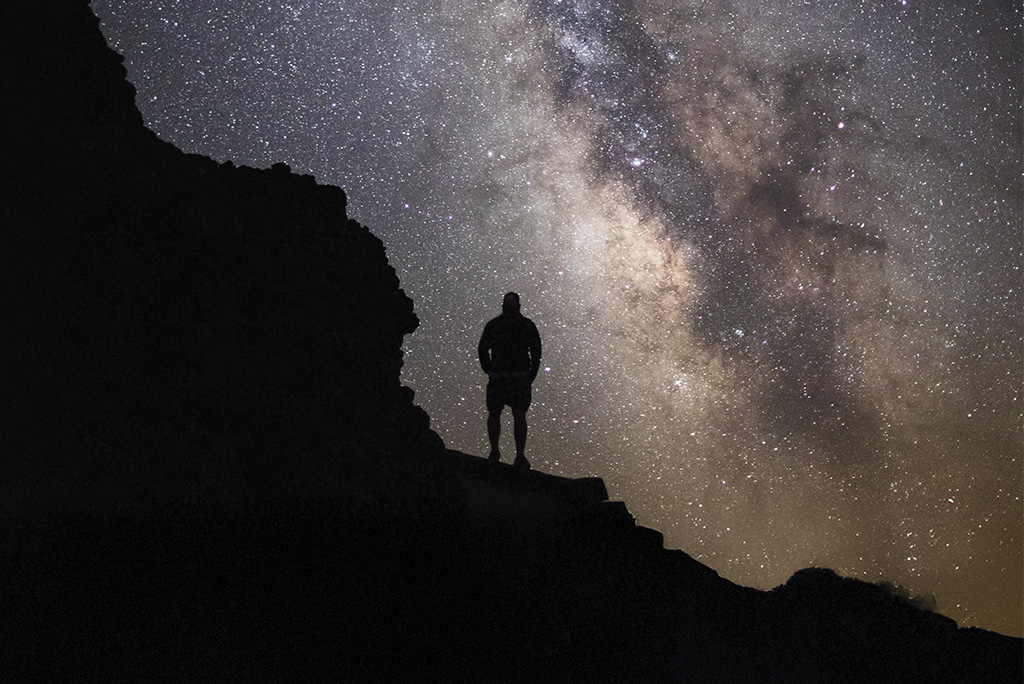
When to visit the park depends on what you want to do. In spring and fall, the weather is milder, crowds are smaller, and the wildflowers are in bloom. Summer brings daytime temperatures that usually exceed 80°F, and the surface of the dark lava rocks can reach up to 170°F. However, the nights cool down and allow for spectacular stargazing in one of the darkest areas of the Continental U.S. Each summer, the park offers evening astronomy programs and constellation tours. Star Parties are held each summer and fall, during which volunteers from the Pocatello Astronomical Society and others provide telescopes and sky-viewing expertise.
Mike Shipman, owner of Blue Planet Photography in Nampa, has spent time in the park shooting photos of both the landscape and the cosmos, such as the Andromeda Galaxy, Orion Nebula, and the Milky Way, along with other celestial objects.
“It’s a great landscape for photography. It’s very stark. It’s not the grand landscapes you’d see at Yosemite or Yellowstone or some of the other national parks, but the lava forms all kinds of fascinating shapes, and there are so many desert plants just exploding with color,” he said.
“The main reason I go there is to shoot astrophotography,” he said. “The sky is very dark, with no light pollution.” While Shipman uses advanced imaging techniques and equipment in his work, he noted that the dark conditions make many celestial views visible simply through binoculars, a camera, or the naked eye.
Astronauts on the Moon
Speaking of stargazing, on August 22, 1969, the Apollo 14 astronauts—Alan Shepard, Edgar Mitchell, Joe Engle, and Eugene Cernan—traveled to Craters of the Moon to learn more about volcanic geology in preparation for their trip to the Moon in 1971.
Because the lunar surface is covered by volcanic material, a visit to Craters of the Moon helped the astronauts become familiar with the geologic characteristics of the rock and soil specimens they would collect during their moon flight. Since only a limited amount of material could be brought back to Earth, the men learned to look for the most scientifically valuable samples.
Winter on the Moon
From November to April, the scenic Loop Road is closed to vehicles and groomed for cross-country skiing and snowshoeing. The park offers ranger-led snowshoe hikes that last about two hours, or visitors may go out on their own. The open slopes of the cinder cones scattered along the scenic Loop Road offer a unique skiing opportunity, as well.
No matter how one wants to spend time in Craters of the Moon, it is, as President Coolidge described, “of great educational value and a weird and scenic landscape peculiar to itself.” And it’s in our own backyard.